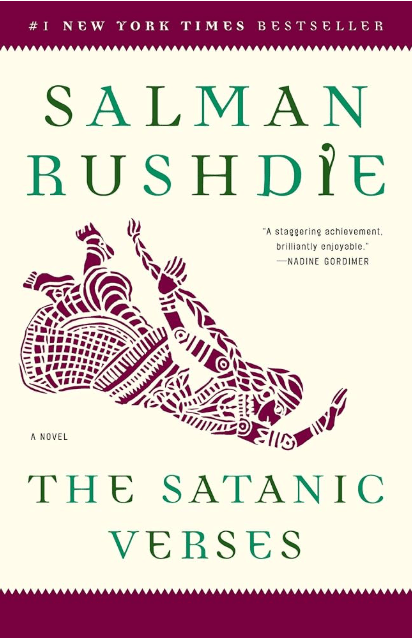
The Satanic Verses
by Salman Rushdie
4 / 5 Stars
The Satanic Verses is classically Rushdie: hilarious, insightful, and a complete uphill battle to parse through.
The novel follows the lives of two men, Gibreel Farishta and Saladin Chamcha (formerly Salahuddin Chamchawala to be more digestible to Western audiences), who are traveling from India to London. En route, they are held hostage by terrorists who bomb the aircraft and send them plummeting through the air. As they descend, they are transformed into supernatural beings—Gibreel becomes an archangel with a halo, and Saladin transforms into a demon with goat legs and horns.
Despite the imagery the title conveys, this novel is less about religion and more a satirical commentary about migration and identity. Rushdie navigates the negative connotations often attached to immigrant communities by others, especially the West, but more damagingly, by themselves.
Through Saladin, we see the unraveling of the multiple layers within one’s identity that often conflict with one another. Harboring a resentment for his father and for the hardships he faced growing up in Bombay, he spends much of the novel denying his roots and seeking validation from the illusion of (British) whiteness he has cast over himself. When truly, it is the love of his father and of India that he truly craves. It is through his chapters that we experience self-loathing, ethnic denial, cultural alienation, and a painful reconciliation of self that while hard won and imperfect, forges onward.
In Gibreel, we see the hypocrisy of religion come to the fore. He is deluded into believing he is an angel above humanity and refuses to take accountability for his actions, often harming others with his selfishness. Through a complex web of characters Rushdie writes about the ways humans tend to perform for an uncaring world, getting lost in their own act.
This book, while profound, is not an easy read. This is not necessarily because the content is harmful—though it does gloss over instances of sexual violence, suicide, and brutality—but moreso because it is dense with religious, political, and historical jargon. Rushdie does not shy away from controversial themes, especially in the way in which he satirizes the Islamic religion.
I often had to pause and re-read a few passages or supplement my understanding of the content with my own (very rudimentary) research. And even then, I felt I likely missed out on some nuggets of gold or witty takes. The novel moves much like a dream sequence and in a surreal pace as characteristic of most books based in magical realism. The order of the novel is nonlinear, often switching from flashbacks, dreams, illusions, and present day and does not have a consistent nor predictable flow; but while the architecture with which Rushdie builds his text is sprawling, he uses understated tones to keep us grounded in the story.
I personally believe there are books that are just meant to be read, some books that are meant to be discussed, and then a very few that should just be studied. The Satanic Verses falls within the last two categories. While I did enjoy my experience, overall, it imparts lessons that aren’t meant to exist in isolation or left fermenting in your mind. They demand reflection and discussion, and community.
I’d recommend this novel for anyone who enjoys a challenge, is well versed in Islamic history, and interested in migration politics and narratives.
Rushdie is skilled at manipulating language in a lyrical way, but in a manner that is both imposing and sarcastic. Neither simplistic, nor gratuitous. And he remains the most admired writer in my arsenal.


Leave a Reply