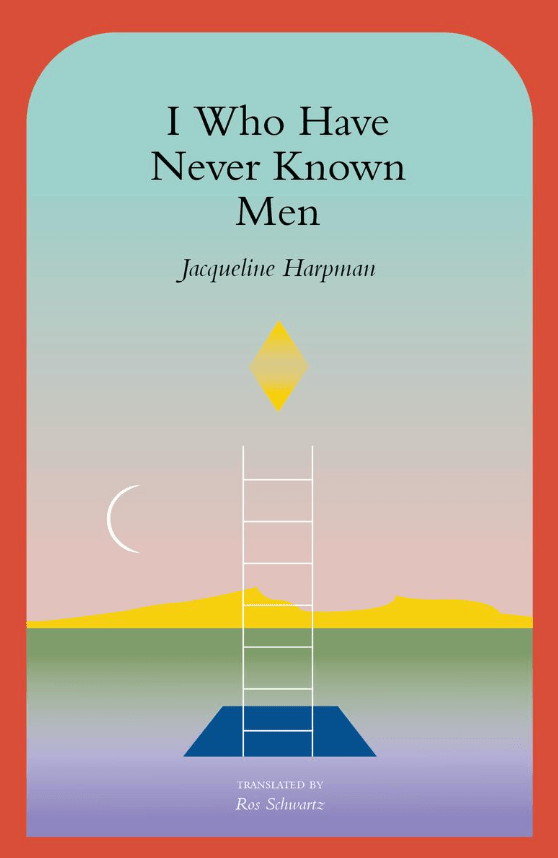
I Who Have Never Known Men
by Jacqueline Harpman, translated by Rose Shwartz
4.5 / 5 Stars
An unnamed narrator grows up in a cage with 39 other women, of whom she remains the youngest by a large degree. There are few rules—
Do not touch each other
Do not show distress or intense emotion
Do not harm yourselves or each other
—and crossing them leads to… well, we don’t really know because the punishments only exist in the imperfect memory of the women. All our narrator is told is that a whip will be lashed, but the fear it illicit stems from the sound of the weapon and not it’s physical impact. Much like, well everything in this novel, the whip seems to exist more in theory.
One day, as the women robotically maneuver through their daily routine, an alarm is sounded and all three of their body guards drop what they’re doing and leave without a word, leaving the door to their confinement open.
Our narrator, the character with a naive sense of braveness, is the first to venture out of their cage. In the most simplistic description I can manage, what follows is Lord of the Flies if it were women and not boys stranded on a deserted land.
I’ll start with my cons before ending on a positive note.
- Our narrator seems to have an inherent sense of courage and detachment that seems almost… unbelievable.
I understand that this is largely explained because she is the only character in the book that does not suffer from loss as the other women—mothers, daughters, lovers—are kidnapped when they are older and have lived life, know what they are missing out on. And while that might have been excusable while they were in the cage and forced to engage as little as possible, it felt unrealistic for her to hold onto her detached, almost cold, sense of self. How can she still profess to not understand deep bonds or profound loss when she performs the act of community every day with the women. Building homes with the women. Breaking bread with the women. Learning and being educated by the women. To have grown and eventually be the last one standing with no emotional ties to the women who raise her feels unrealistic. - We never get any answers. Like… literally nothing.
I was reading that this books is an allegory for the Holocaust—the senselessness of it; the separation of the women from the men; the banality of evil; and the routine ignorance and robotic participation of the guards; and more. And while war and violence are essentially senseless and this narrative choice was intentional, coming out of the novel with no answers left a disquieting void in me. I suppose that’s a personal issue, but really! No answers! Like at all!
We don’t know who put them there. Why they were put there. We don’t know what the alarm was for, or where the guards went, or how large the actual land is. We don’t even know if they’re on earth or another planet.
We went through that emotional turmoil, being thrust into an unsettling world with no closure nor emotional payoff. And while I admired the main character for her bravery, her curiosity, and her detached way of showing “love” for the other women, I had wanted a better ending for her.
Despite my qualms with the story, I truly did enjoy my experience of it. It wasn’t the ending I had hoped for, but it a weird way… I don’t think it would have worked better any other way. I imagine any answers Harpman would have given her readers would not have had as strong of an impact nor have been as believable. And while it may kind of come off as a copout, perhaps it was the best choice for a novel such as this.
I say, read it. I was engrossed and finished it in one sitting.

 Via Justine De fant
Leave a comment