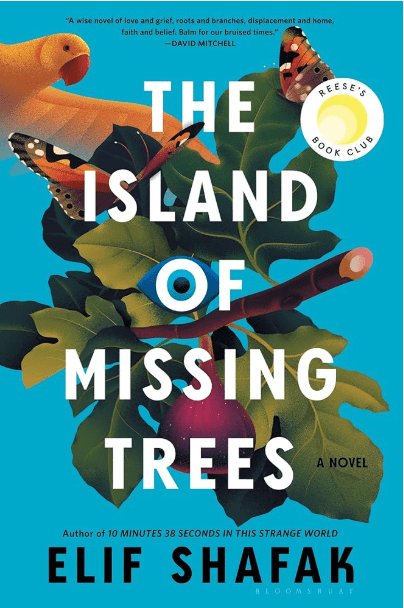
The Island of Missing Trees
By Elif Shafak
4.5 / 5 Stars
I’m midway through a new book and still, I can’t stop thinking about this novel.
The Island of Missing Trees toggles between two primary settings: London in the 2010s and Cyprus in the 1970s/2000s, and three main points of views: Ada, Kostas, and the Fig Tree.
In the first chapters, we’re introduced to Ada Kazantzakis and her father, Kostas—two people struggling to find connection in the midst of their grief and a new routine in the aftermath of Dafne’s death, Ada’s mother and Kostas life-long love.
‘I just want you to be happy,’ said Kostas, a knot in his throat.
And then they were silent once again, drifting back to the painful place they both shared but could only occupy separately. (158)
Early in the novel, we learn that Kostas is a Greek Christian and Dafne is a Turkish Muslim who fell in love in their youth and immigrated to London in search of a new life.
Ada, born and raised away from her ancestral lands, and knowing little to nothing of her parents’ tumultuous past and the violent history of Cyprus, learns that there are shadows too deeply embedded in her family tree that cannot always be overcome, and horrific memories caused by nearly a century of inter-communal violence that will never be forgotten.
The historical context of the novel is deeply embedded in the bilateral tensions and divisions between the Republic of Cyprus that is primarily made of Greek and Christian communities and the Turkish Muslim community in the Republic of Northern Cyprus.
Inside these pages, we witness the seeds of healing in the next generation, the shadows that follow immigrant families who must assimilate into a foreign land where they are Othered, and the deeply moving observations of the natural world.
Interspersed throughout the narrative are the observations of a Fig Tree, who is transplanted from Cyprus to London by Kostas, a botanist with an unyielding admiration and devotion to plants and animals. He is a man that cries over a horde of dying bats rather than a soldier who dies in war.
It is this unrivaled empathy for non-human beings that causes the Fig Tree to fall in love with him. Admittedly, this was a bit weird but it’s in no way inappropriate or perverse in its portrayal nor does it occupy more space than is necessary in the novel. Still. Weird. lol.
The Fig Tree forces us to stop and think about the ways humans often center themselves as the primary victims of war, hardly giving thought to the natural world that sustains them. Birds, bees, the soil, the trees, and all manner of life are impacted by the conflict between the Greek and Turkish nationalists (and other war-torn communities), but are often casualties of violence that are never spared a thought.
It happens to parrots, just like humans, they succumb to melancholy, losing all joy and hope, finding each day more excruciating. (278)
In her chapters, we learn about the natural cycles that sustain the earth while humans simultaneously work to destroy it. Her insights become a prism through which we reflect on the lives of the characters, and in her memory we bear witness to their blossoming love, their losses, and their unwavering bonds that outlive the bodies that carried them.
This novel is a standout in so many ways that I’ll fail to convey through words. Ada, who begins the novel as saturnine as any teenager struggling to understand their identity, begins to process the grief that keeps her isolated from her father, and by extension the history he carries in his memory that will help her make sense of herself. Slowly, he leaves her with tidbits of his past that are revealed more readily by her eccentric aunt, Meryam.
I think what Shafak does best is that she doesn’t write about any profound discoveries or revelations for any characters, but rather, she shows you the seeds that they toil for and plant to become better versions of themselves. It is the reader’s imagination and hope for their happiness that makes up the rest.
I was deeply moved by the way Shafak writes Dafne, an unconventional woman by traditional standards. She is someone who rebels against the expectations of a strict society. She sneaks out late into the night to cavort with her lover. She smokes, she drinks. She’s an alcoholic. She struggles with mental health. She remains unwed well into her late 30s, preserving her autonomy and shapes her life according to her own passions—art, archaeology, and later on her family. She walks fast, she speaks her mind, she’s intelligent, and loyal, and she is unapologetically flawed.
I won’t speak for other readers, but I have a tendency to put characters on a pedestal, and constantly have to check my expectations of them. I assume that their actions will align with my own ideals and sense of morality. That even if perhaps their choices don’t make sense to me, that it somehow serves the greater plot and purpose. That on some subconscious level, they have some underlying sense of what they must do and I must trust them.
But Dafne defies this notion. I had hoped for a happier ending for her, some sort of proof that she has made it to the other side alive and thriving after all she had gone through. I yearned for the fruits of her labor and a freedom from the shadows that tethered her to the horrors of her past so that she may find true healing.
And while she did find something rare: a love as as true and enduring as the one she shares with Kostas, as well as a deep and irrevocable bond with her daughter—it was not enough to save her. The pain of past could not be reconciled, at least in her current life.
It almost felt like… oh, so all that was all for nothing.
AND I GET IT. The point isn’t a neat resolution, and her death rejects the idea that we can heal our deepest wounds if we do this, or that or have true love. But life and our desire to cling onto it is never that simple.
SPOILER Ada and Kostas allude to her death as being caused by suicide. And in the end, we find that she has transformed into the Fig Tree so that she may hold onto the bond with her family and continue to watch over them. I thought this was an interesting way to portray a character who is struggling with mental illness that has been carried across time and into each generation (we see the seeds of it in Ada), but who still resists her own vanishing.
Her and Kostas are emblematic of the differences between those who stay in a country in the midst of its turmoil and those that choose to leave. They both experience, in some way, the effects of the violence but one is more removed (Kostas) while the other is directly impacted (Dafne). END SPOILER
And while I do appreciate Dafne’s complexity, some part of me kind of feels like she’s a bit unrealized. Her character functions as a thematic figure, a vehicle to convey the theme of mental illness that’s rooted in generational trauma. And we experience her from the POVs of others, but I felt as if I was experiencing her from a lens that was disconnected from the main story. My experience of her feels bereft of the interiority that would have really allowed me to feel connected to her. I felt more pain watching Kostas struggle through his disconnection with his daughter than Dafne’s pregnancy and loss. Alas! Perhaps that was the point. I can’t say for certain.
Then we have Maryem, who for all intents and purposes, contrasts her rebellious sister. She follows the path that is expected of her. She marries young, turns a blind eye to her husband’s affairs, and she sticks to tradition and superstition. Not without her own struggles with the past, she brings a liveliness and proverbial (lol) attitude that injects humor into the novel. She is the reason Ada is able to find a way back to her roots, to her culture, and to her parents.
‘Don’t you worry. God made lower branches for birds that cannot fly so well.’ (195)
‘The bear knows seven songs and they are all about honey.’ (196)
Another part of the novel that remains seared into my mind are the sections with Yiorgos and Yusuf. One is a Turkish man with a stutter that disappears when he’s talking to the trees, the other is a Greek man whose outgoing personality balances the introverted nature of his partner.
Yiorgos and Yusuf are the owners of the Happy Fig, a tavern where the unshakeable bonds of the novel blossom and fruit (pun intended): it is where the Fig Tree, planted inside the very center of the building, meets Kostas and Dafne for the first time; it is where our lovers build a haven away from the political tensions pervading their reality (which, sadly, falls too soon); and it is where those who want to defy the fractures of history can go to briefly suspend time and find reprieve and laughter.
My god, stab in the heart and twist the knife. These two men, too, must hide their love in private but they continue to navigate the world with a light and sincerity that spreads warmth to those around them. It is their storyline that made my tears flow steadily, but I won’t speak too much on this lest I spoil too much and rob you of the unbearable ache that elevates a novel from good to great.
I’ve left the book and still I want to be with these characters who are not wholly healed, but who are fighting for the fortitude that will carry them forward. I want to watch them build a life despite the grief, find happiness, and learn to embrace the memories and the history that has shaped them, painful as they may be.
There’s a resounding note of wistfulness and promise that lingers even after you finish the last page.
I cannot recommend this book enough.
You know what I’ve been thinking since? I’ve been thinking that you are my country. Is that a strange thing to say? Without you, I don’t have a home in this world. I am a felled tree, my roots severed all round; you can topple me with the touch of a finger.
a letter from Kostas to Dafne – Cyprus, July 1974 (179)
Note: I wish I knew more about the history of Cyprus before reading The Island of Missing Trees. Though you can go into the book unequipped with prior knowledge of the geopolitical tensions between Turkey and Greece and piece it together in context, I feel the impact would be greater if one had a deeper understanding of the history beforehand. So, here are some quick resources I found that shed light on the conflict that sets the stage for the novel.


Leave a comment