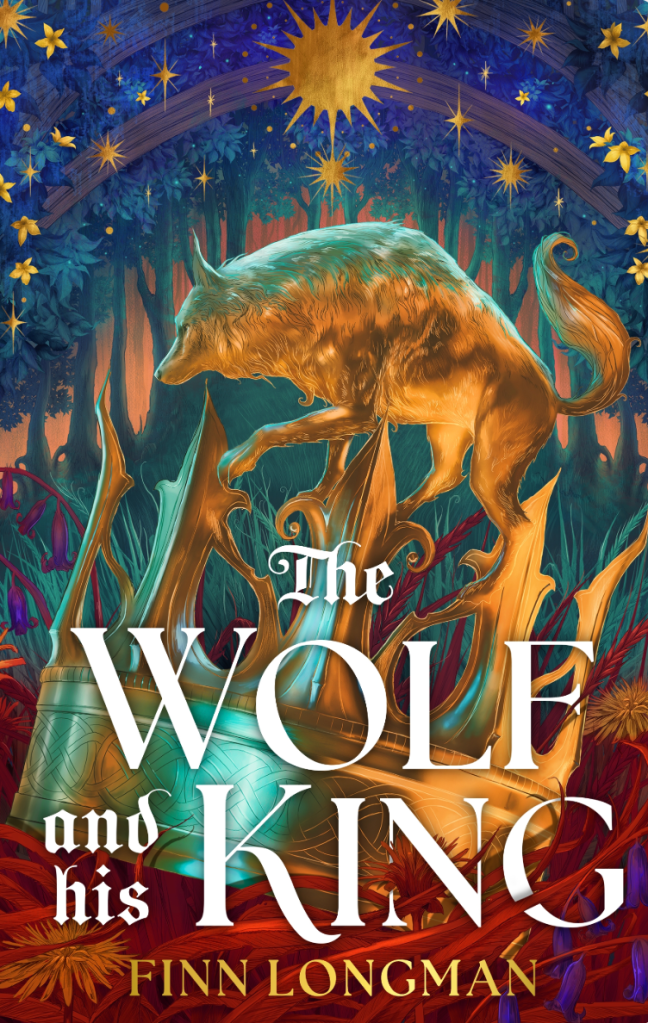
The Wolf and His King
By Finn Longman
4.5 / 5 Stars
Cursed with lycanthropy since he was a child, Bisclavret is doomed to shift into a wolf against his will. The transformation is as unwelcome as it is sporadic. There is neither time nor place that will predict when he will shift next and no pattern to identify that might ease the anxiety of his painful transformation.
Afraid of the control he loses when he is a wolf, he exiles himself from the life he’s always dreamed of: knighthood, brotherhood, belonging.
It isn’t until his cousin, a knight himself, convinces Bisclavret to swear his fealty to their new king that he embraces a hope for a future he once thought was beyond his reach.
The king, a man not much older than Bisclavret, ascends to the throne against his wishes, not feeling fit for the large shoes his father left behind. But upon meeting Bisclavret, he is instantly captivated by his stoic mien and reserved yet noble demeanor. Driven partly by Bisclavret’s own request for knighthood, but mostly by a clawing desire to keep him close, the king knights him soon after.
But the king is not alone in his growing affections for this stranger. Others in the court have also taken notice, including his beautiful and beguiling ward who is determined to take Bisclavret as her husband.
What follows is a poignant retelling of betrayal, unrequited love, longing, isolation, and monstrosity—all working together to capture the raw yearning of two men learning to come into their own identities.
Bisclavret is the Norman word for werewolf. It is his name that brings him back to his humanity, that gives his body and mind their shape. When he is a wolf, he is nameless. Wild. Untethered to his mortal identity. His name gives him meaning, and this is why he is the only character in the novel with a proper name.
Despite this narrative choice, the king is the emotional anchor of the narrative. The themes of loneliness, loyalty, and salvation are more intentionally explored through his eyes. It is his longing that compelled me to turn to the next page.
In his actions and thoughts, we see him as a kind man with a desire for peace in a war-hungry world, an unfavorable sign of weakness in a court that yearns to fight and to earn honor and glory through violence. He finds it difficult to connect with those around him, not just because of his lack of bloodlust and their desire for it, but because of his crown, which separates him from feeling true camaraderie. This ache mirrors that of Bisclavret, who also yearns to belong. In their respective sections, I feel their emotions—their pain, their hopes, their betrayals, and their doubts. It is wonderfully executed through Longman’s writing that is grounded and introspective and completely enveloped in unrestrained yearning.
The king’s sections are written in second person, immersing the reader in the story. Bisclavret’s chapters are written in third person affording us some distance from the depths of his emotions, and his wolf form is written in a poetic, disjointed rhythm that vacillates between coherent thought and animal instinct.
My only issue—though it’s one that does not take away from the overall impact the novel had on me—is that the relationships did not feel wholly believable or realized. While I can see why Bisclavret’s noble and mysterious character endeared him to those around him, I felt like everyone fell under a spell and admired him way too fast. His brief time at court was not enough to warrant the unyielding devotion and love the king feels for him almost right away. They also don’t spend as much intentional time with one another, often only sparring and interacting briefly so as to avoid any courtly rumors about their cavorting (although, it’s well known at court that the king has only preferred men—still, he limits their interactions to protect Bisclavret).
That being said, the grief the king feels over Bisclavret’s “death” seems almost naive and fanciful in its intensity.
But I say that with my realist hat on. If I suspend disbelief, which I did during these parts, I truly feel the painful yearning and reverence the king reserves for Bisclavret alone. And I feel the sincerity of the kings love more readily than Bisclavret’s to the king.
Tiny Spoiler Ahead
Which brings me to my qualms regarding the love Bisclavret displays for the king that had not been explored deeply enough to warrant the intensity of his loyalty in the second half of the novel when he is no longer human. In fact, he spends a majority of the book denying himself of that exploration, choosing to suppress the inner desires he has for his king in favor of the ward, who becomes his wife.
Bisclavret has always been loyal to the king but his devotion becomes more pronounced after he is trapped in his wolf form following the betrayal of his wife and his cousin, characters whose swift change of heart also feels unearned, or perhaps unexplored. The cousin’s betrayal was not as surprising, heartbreaking as it is, but his wife’s sudden change of heart felt off. For a woman who opposed societal expectations by demanding she have a say in who her husband should be, regardless of rank of status, as well as being adamant she marry someone with a kind heart and unwavering integrity (i.e. Bisclavret), she completely shifts into a new person who is cowardly when once she had no fear. And vindictive when once she valued honesty and kindness.
Though it was clear why both characters did what they did— that is, to feel safe, to secure wealth and land, and to indulge in their affections for one another— it felt as if the love and loyalty that they had displayed so earnestly for Bisclavret dissolves solely to move the plot along.
Perhaps that is the point. That the real monsters don’t look like monsters at all. Or perhaps Longman wanted to stay true to the original version of this story. In any case, it was the only real issue I had with the story.
End of Spoiler
Regardless, this did not take away from my enjoyment of the novel because the king and Bisclavret’s feelings (both individually and together) were the focal point of my attention. It is through their devotion to one another, through their journey toward healing and self-love, that renders every other aspect of the story secondary.
If you like longing, grounded prose, emotionally driven characters, and lyrical retellings of myths, you’ll likely enjoy this story.
Note: This is a retelling of the classic 12th-century medieval tale Bisclavret, originally written as a Breton lai by Marie de France.


Leave a comment