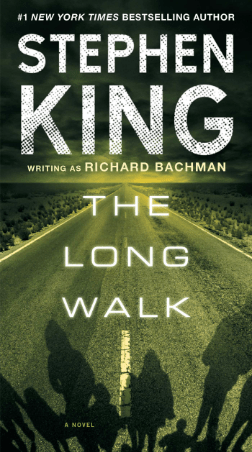
The Long Walk
By Stephen King (writing as Richard Bachman)
4 out of 5 Stars
100 boys from the country are chosen to partake in the Long Walk. The rules are simple. Walk no less than a 4mph pace for as long as you can. You cannot veer off the path. You cannot receive help from anyone outside of the competition. And you cannot stop.
If you do, you are given three warnings before you’re shot on the spot. And you keep walking. And walking. And walking. And walking. Until there is only. one. boy. left. The winner of the Long Walk receives a “Prize”: anything he wants for the rest of his life.
What a disturbing and heartbreaking novel. I need someone to send me Stephen King’s address so I can send him a long and scathing letter.
The novel follows the perspective of Ray Garraty, a 16 year old boy who wins the “lottery” and enters the Long Walk. I should add that this is completely voluntary. Alongside him are an array of young boys who begin their journey with optimism that soon fades and transmutes into madness and brings out a feral hatred for the world (that I suspect was always hiding beneath the surface, because why else would one agree to partake in something so gruesome).
King is a master at crafting characters that stay with you and drowning you in depth with the use of minimalist language.
Reluctantly, I grew to appreciate all the characters in the story, which only made it harder to watch them each succumb to psychological breakdowns. Despite their descent into madness, however, their compassion for one another only grows stronger as they embark even farther on their journey—undoubtedly because they’ve bonded through their shared trauma.
I had anticipated that rivalry would ensue and that the boys would find some way to sabotage the other competitors, but I think that this growing humanity in each of them, beside the increasing disdain for the real villains (the Major and the sadistic onlookers and crowds who perpetuate the violence in the Long Walk), is what shifts this novel from horror to tragedy.
SPOILER + Movie Comparison.
There’s a pervasive feeling of hopelessness in the end with Garraty winning the Prize, but being so psychologically damaged that he cannot even comprehend that what he’s running towards is just an illusion. He is running away from what he spent almost 5 days and over 400 miles toiling for, driving home the point that there are no winners in this life.
While this book is piercing, the movie just can’t be outdone. Perhaps that’s why I struggled to give this a full 5 stars. Garraty lacks the same motivation that’s presented in the movie. He has no real reason to join the walk—at least one that he can admit to. I suppose that’s why King wrote it as a metaphor for the Vietnam War. Young men—no, boys—signing away their lives not truly understanding their reasons for doing so.
I also could not suspend my disbelief when Stebbins, who had been the strongest competitor from the start, falls to his death at the finish line. I suppose I could dig deeper into the symbolism behind his sudden death, but it felt like a cop out to me and that’s why I struggle between rating this novel a 4.
The ending for both the movie and the novel differ just slightly. Both good endings that stick with you though.
END OF SPOILER
The historical and political layers of war, the implications of queerness and blooming attraction between boys who can never actualize their feelings, and the pervasive undertones of human depravity and institutional violence are what make this story unforgettable.
I’d suggest reading the book first and then watching the movie. I had a hard time removing myself from the novel because I constantly compared it to the movie. Both are haunting in their own way. While the book is just as gruesome and violent, I think we often filter horror or tragedy through our own levels of tolerability. The movie affords you no such comfort. The visual imagery impacts you in much different way, and the motivations of the characters are explored more deeply, making it all the more devastating as we lose them all one-by-one. So much is said in a single look.


Leave a comment