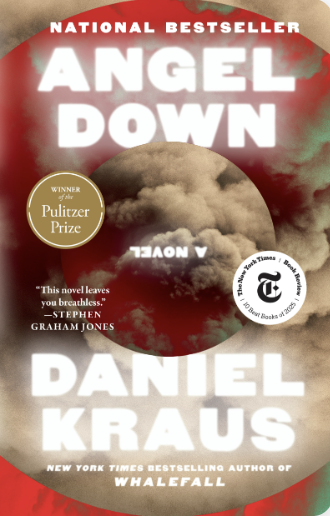
Angel Down
By Daniel Kraus
5/5 Stars
and so let me leave you with this: if you’re a fan of experimental styles, and the complexity of human design, and if you hold on to a bit of hope even in the midst of pervading despair, few books deliver a more haunting picture of survival,
and in the cacophony of explosions and the endless cries of dying soldiers, a ceaseless wail reverberates across the war-torn landscape of the Meuse–Argonne offensive in France, tasked with finding the source of this ear-splitting, unendurable sound, five World War I soldiers traverse the carnage of Bois de Fays to euthanize this dying soldier and end both his and their suffering,
and in their ranks are Vincent Godspeed, the “Vulture” known for robbing dying soldiers, Hugh Popkin, a lummox and bear of a man devoted to a woman named Effie back home, Ben Veck, an African American flamethrower operater suffering from severe shell shock, Lewis Arno, a 14-year-old orphan who lies about his age in an effort to join the US military and forge a found-family in war, and Cyril Bagger, the novel’s protagonist and anti-hero,
and in the midst of No Man’s Land, these five men find not a wounded soldier but an angel garbed in a red dress and blue cape, one who does nothing but grants wishes, and what follows is a gruesome unlayering of human depravity, desolation, and destruction that’s deeply and irrevocably woven into the very fabric of war,
and Angel Down is unlike anything I’ve read before, the novel is written in one continuous sentence with each paragraph starting with “and” and ending in a comma, both of which serve as a thematic mirror to the narrative and metacommentary on the ceaseless nature of human violence and our propensity to conquer and destroy—a never-ending cycle, or sentence, which comes full circle at the end,
and while I’ve read several reviews arguing that Kraus’s stylistic choices feel gratuitous, I thoroughly enjoy the way he plays with diction and syntax, each sentence is a fluid transition into the next, even during the parts that are intentionally disruptive, which I think is the whole point, the gruesome imagery contrasted with the lyrical writing creates a rhythm that emphasizes the ways humans, from the dawn of time and far into the future, are drawn to bloodshed and war, beauty and horror sliding against one another in an orchestrated dance,
and beyond Kraus’s writing style, is the characterization of each of the men, each soldier is distinct and visible in my mind, regardless of how unpleasant they may be, and Bagger, himself, is someone I can’t help but to root for despite being concerned with his own self-interest for most of the novel, with the only exceptions being the angel, with whom he is unexplainably drawn to, and Arno, who he looks at like a younger brother, and it is this begrudging love for the orphan that ultimately impacts the major choices he makes in the novel, which becomes more and more apparent as you progress,
and Bagger also loves seeing Lewis Arno, and there’s nothing he hates more than love, so he snaps, “What do you want? Little trench rat,”
and Kraus forces us to confront the paradox of humanity through Bagger and through the war, a character in-and-of-itself, which is laid bare at its core in the final chapters, with Arno, and the world, serving as the innocence we strive hard to protect, despite all odds against us, which often includes ourselves,
and like a gear in a war-machine, we are undeniably racing towards our own destruction, inexplicably captivated by our own descent, a realization that is especially timely in this era of political shifts and discord,
Genesis incorrect after all, life doesn’t beget life, it’s death that begets death, so foundational a principle it has become civilization’s engine, an inferno of grief that, nut by screw by rivet, is refashioned into outrage and hysteria and vengeance and moral polarity, a cycle perfected by the so-called War to End All Wars, which, Bagger understands with horror, is really the War to Begin All Wars,
and, if I had to identify one thing that irked me, it is ironically, the way Bagger begins to act out of character towards the end, as he’s initially portrayed as a cool and calm con artist who wins because he is skilled at reading his opponents, yet he takes uncalculated risks due to the pressure he feels to save Arno, which lead to consequences even I saw coming,
and it’s a small flaw in the grander scheme of the novel, but one I couldn’t help but notice, and one that won’t stop me from giving it a 5/5 stars,
and so let me leave you with this: if you’re a fan of experimental styles, and the complexity of human design, and if you hold on to a bit of hope even in the midst of pervading despair, few books deliver a more haunting picture of survival,
I wanted to experiment a bit with this review, though I recognize that getting through it is cumbersome even for me; alas! I have no will to revise and must leave you with it as it is (read: It’s 10pm, and I’m lazy af). If you’ve made it to the end, thanks for reading!


Leave a Reply