
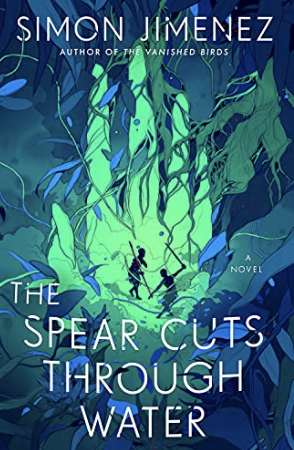
The Spear Cuts Through Water
by Simon Jimenez
In the early days of the Old Country, an emperor frees the Moon by cutting her out of the sky so that she may escape death by hiding out on Earth. In exchange, she bears him three sons so that he may continue his legacy. Soon thereafter, the emperor betrays her and locks her away so that he can control her divine power and live forever.
In the years that follow, the emperor raises the boys who yearn to be close to their mother, but under his tutelage inevitably become tyrannical leaders who wreck havoc over the Old Country, spreading unrest and bloodshed wherever they go.
The eldest of the sons, the First Terror, controls the elements and sires three sons, of whom Jun is his most favored; the Second Terror, the most grotesque and irredeemable of the three, has power over human thought; and the Third Terror has the power to shapeshift into any animal, with his natural form being that of a wolf’s head on a human body. Fearful of his youngest son’s monstrous visage, the emperor hides him away from the world and leaves him to be raised as a beast.
It is only when Jun and Keema, a crippled boy of unknown origins, free the Moon goddess and kill the emperor that the wrongs of the past can be reconciled and the two boys find the bravery to pave a path of their own making.
There are so many complex layers shifting and moving the narrative of The Spear Cuts Through Water by Simon Jimenez, but at its very core this is a love story. Love between the First Terror and his sons; love between the Moon and her children who were raised to torture and despise her; and love between the two young men who must grapple with the violence of their pasts in order to build any hope for their future.
The framing of this novel mimics that of oral storytelling. In the first chapter, a lola is telling her apo, or grandchild, the story of the Inverted Theatre—a supernatural amphitheater born out of the love between the Water and the Moon. And it is here where the two protagonists of the novel, Jun and Keema, act out their lives to an audience of dreamers destined to forget this play when they wake.
Readers are essentially watching this story, or play, through the eyes of the grandchild, now a man, in the present day, while the story of the Moon and her lineage transcends the confines of space and time.
Jimenez is a gifted storyteller. Spear is nonlinear and polyphonic and works within a multi-framed structure. This design allows for a dreamy and mythic exploration of heavy themes including trauma and healing, generational and historic violence, and distorted forms of love—all while maintaining enough distance so readers can still be immersed in the emotions while not drowning in them.
Despite this unique style, however, I found the narrative to be a bit disorienting at times. Voices from periphery characters often interject themselves within the main narrative, distracting from the thoughts and scenes of the main characters. And some parts of the novel felt a bit dense with lyrical prose.
I wouldn’t necessarily say the writing is gratuitous or isn’t beautiful in its own right, but the experimental structure and dream-like movement of the writing did come at the expense of immediate clarity. There were many times I had to reorient myself in the novel to get a clearer grasp of where I was being dropped off.
I think this is why it took me a while to finish this book. I definitely think it’s a novel that you have to sit with and digest section by section rather than speed through to really appreciate and understand. It could be 50 pages shorter and still be memorable.
My favorite part of this story is the complexity of the main characters. Many of them are selfish, greedy, or filled with ill intentions and yet each one has some redeeming quality, some semblance of humanity that they either choose to indulge or cast away with their next action.
For instance, the First Terror begs his son to come back home, but at Jun’s denial, rather than lash out at him, which is what one might expect from a tyrannical and violent ruler, he expresses compassion and unwavering love—it’s an interesting exploration of the contrast between a loving (albeit manipulative) father and a controlling and brutal man.
“‘I’m going to save you all the same.”
His relationship with Jun, as well as the relationship between the Moon and her three sons, is as painful as it is beautiful.
Truthfully, the ending redeems nearly every qualm I have with the novel. I was in tears at the way Keema and Jun grow into their love for one another. It’s leagues away from being “romantic” in the traditional understanding of love, but it’s intimate in a way that would only make sense in a world filled with bloodshed, trauma, and violence.
Triggers readers should be made aware of:
Graphic violence and bloody imagery; gruesome dismemberment; suicidal ideation; psychological abuse; implied sexual violence.

 Via Justine De fant
Leave a comment