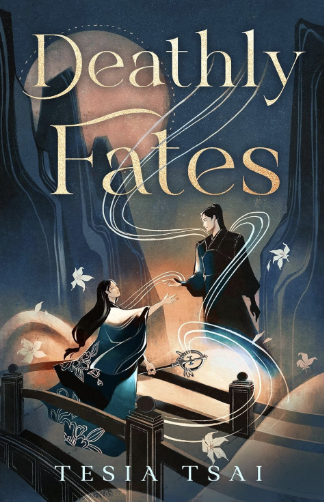
Deathly Fates
By Tesia Tsai
3/5 Stars
In Deathly Fates, we follow Kang Siying, a ganshi priestess who reanimates the dead so they can be reunited with their loved ones. It’s a lonesome life. Those who come across the priestess and her walking dead, devoid of all thought and consciousness, steer clear for fear of bad luck.
And Siying likes it that way.
That is, until she comes across the corpse of a fallen soldier straddling the line between the living world and the afterlife, an occurrence that is unheard of. Tasked with reanimating the corpse of a fallen soldier, she soon finds that it belongs to Prince Renshu, or Ren, the second son of the Emperor of Sian. In exchange for her services—deliver him safely back to his home alive— Ren offers Siying a life-changing sum of money that she can use to aid her ailing father, the driving force behind all her choices in the novel. Together, they journey through the kingdom searching for lingering spirits to exorcise so that Ren can absorb their qi, or lifeforce, and live.
The premise of this YA novel is captivating as it is unique. A corpse-driving priestess and half-living prince exorcising vengeful spirits isn’t a plot you come across often. Though grating in the first half of the book, Siying’s frigid exterior and unyielding disposition lent itself well to her purpose. I can’t imagine having to scour war-torn lands and experience loss without developing a protective layer of coldness and pessimism about the world. Regardless, it served as a counterbalance to Ren’s often too naive and optimistic nature. While I understand this functions as a vehicle for his own personal growth and character development, I often found myself rolling my eyes at him. I didn’t come out of the novel believing he would be a good king. A kind one, yes, but firm, steadfast, and responsible, no.
*Possible Spoilers*
This leads me to the pacing of the novel, which I felt was rushed in areas it needed to slow down. Ren, who lived his whole life refusing to take the crown, assuming responsibility for his kingdom at the end felt contradictory to his character, who is often displayed as naive, carefree, and light-hearted. Even Minister Zheng, who was obstinate and unwilling to move on into the afterlife, was quick to abandon what seemed to be his core motivation when it came time to exorcise and purify his spirit.
I also felt the novel missed a lot of opportunities to delve deeper into more profound lessons of grief and purpose as these interactions often felt superficial and lacking. Perhaps this might be due to the dialogue, which felt stilted at times, and chapters with the lingering spirits felt almost rushed and formulaic in their execution: Find a vengeful spirit. Vengeful spirit doesn’t want to leave. Vengeful spirit has a valid reason for its hate. Vengeful spirit must be purified.
This isn’t to say that Tsai should have followed a different structure or needed to be overly unique in her treatment of each exorcism. I just felt these moments lacked tension and depth because we were rushed through their storylines.
Overall, this wasn’t a bad read by any means. The ending, while also rushed, ties up with a happy ending and the promise of a happier Sian for the future.


Leave a Reply