
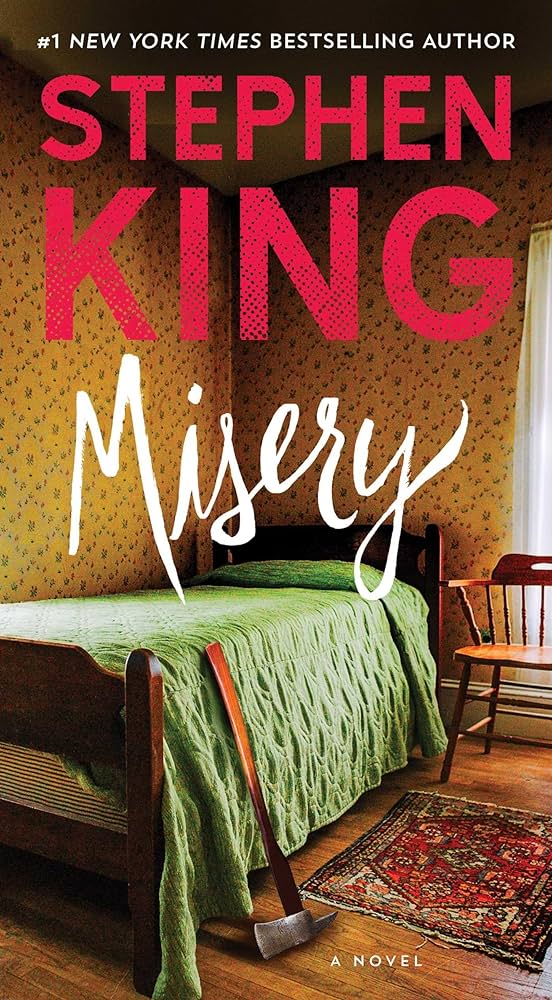
By Stephen King
June 8, 1987 • 370 pages
5/5 Stars
Unnecessary Backstory (feel free to skip ahead):
My first King novel was Needful Things, which was an assigned reading for me in undergrad. I was intrigued by the premise, but wasn’t too amazed by the execution. It didn’t have the same level of gore or fear or suspense that was purported to me by King’s more regular readers. So, I never felt the urgency to pick up another of his novel despite knowing I would one day. At that time, I was also insufferably pretentious and was turned off by the mass consensus that King wrote for 7th graders. I was too sophisticated for that and would rather pretend to understand Deleuze and Guattari.
(I’m totally kidding.)
The second title I read by King was On Writing: A Memoire on Craft, and I picked it up because it came highly recommended by good friends of mine whose tastes I trust implicitly. (Thanks Kiana and Nikko!) And WOW! What an amazing, hilarious, and insightful read. He also references Misery a few times in his memoire. This was the turning point for me and what first put Misery on my radar.
Admittedly, I would pick up a copy of this book on a few different occasions when I’d visit my local bookstore and go back and forth on whether or not I’d want to spend the $10 to read it. The plot interested me, but I’d always find another book I’d want to read more.
I’m glad that the fifth time (or so) I came across Misery, it had no worthy contenders because now I am now a HUGE fan of King. Maybe not Annie Wilkes huge, but pretty high up there.
My Actual Review:
Paul Sheldon, famed author of the Misery novels , wakes to the excruciating pain of his battered body and the putrid breath of his savior, Annie Wilkes, who has just resuscitated him from a car crash and taken him to her home to nurse him back to health. The catch? Annie is his number one fan. She’s also batshit crazy and a serial murderer.
Thus begins a battle of wills and survival, and the question that runs rampant throughout the novel is what will Annie do next?
Think: the worst you can imagine!
While the writing of this novel is not sophisticated, it’s definitely not simple. This book is so cleverly framed. It is a story within a story. While we’re reading the harrowing experiences of Paul Sheldon and uncovering the horrific mind of Annie Wilkes, we’re also reading the duplicitous love triangle of Misery Chastain, the protagonist of Sheldon’s bestselling novels and Annie’s point of obsession.
This book is grotesque and suspenseful.
During the more visually grueling chapters, I found myself covering my eyes in a weird attempt at sensory deprivation—as if the curtains of my fingers would block the mental image of crushed bones bent at odd angles or the spraying of blood and viscera. It was dirty and disturbing.
I was kept on the brink of my seat until the final few pages not knowing what Paul’s fate would be. One thing I appreciated was his unwavering will to live. If I were him, I’d be ready to met my god by page 50. He’s not the most noble of characters, but you desire his freedom as if it were your own.
I’d say my only small gripe would be that Annie is not a complex villain—which helps move the plot along, but I felt I missed out on something that could have been great. She’s a little too predictable, and I didn’t really understand the whys of her corruption. Although her past murders were often framed as being a product of her own inherent disdain of the world and the people it puts out, I felt like she was just evil for evil’s sake. There’s nothing wrong with that per se, but it seemed a bit shallow. It was as if I got a taste of her psychosis through Paul’s own musings, but missed out on a potentially satisfying feast. (Did that analogy go too far?)
The concluding pages, while a bit predictable, were still satisfying. King interweaves the Paul/Annie storyline seamlessly with narrative devices meant to fill in the gaps: childhood flashbacks, horrific newspaper clippings, unimaginable torture, and chapters of “Misery” being written by a typewriter without any ‘n’s and ‘t’s and ‘e’s—which, btw, was a small but brilliant detail.
I thoroughly enjoyed the mental torture and anguish this book put me through. King knows how to move a plot forward. He knows how to write a good story. And I’ve already lined up my next read by him.

 Via Justine De fant
Leave a comment